
Baphomet was a god that the Knights Templars were accused of worshipping in ceremonies in the 14th-century and were imprisoned by King Philip IV of France. Some of them that were tortured admitted to worshipping Baphomet. In 1856, Éliphas Lévi drew the first depiction of Baphomet that took the form of a semi-human-semi-goat hermaphrodite, with a caduceus where an erect phallus should be and its arms (one female and the other male) in the “As Above So Below” position. The principle of “As Above So Below” is thought to be in relation to the macrocosm (the realm of God) and the microcosm (our physical world) and how through the Tree of Life, we may learn to unite them, thus accomplishing the Great Work. According to Tracy Twyman, in her book ‘Baphomet: The Temple Mystery Unveiled’, Lévi explained that Baphomet was “a symbol of transcendental power beyond good and evil, man and beast, or male and female energies, capable of performing any transformation of matter that the human mind could conceive” and represented the “synthesis of all energy, both on Earth and in Heaven”.
It’s generally assumed that Lévi’s Baphomet should be seen as a symbolic representation of his magnetistic-magical concept of Astral Light. In his 1860 book ‘Histoire de la Magie’, Lévi referred to Lucifer as representative of the “Astral Light”. In his book from 1846, the German philosopher Heinrich Chalybaeus compares Adam Kadmon to Lucifer. He says: “Adam Kadmon emerges, but the separate existence of the natural orders and the existence of many individuals either cannot be explained at all or must be explained by the new, adventurous hypothesis that Adam Kadmon, Lucifer, or whatever else he may be called, through a primal crime the original organic unity was destroyed, fragmented into nature”. Baphomet might be interpreted as a symbol of the restoration of Adam Kadmon’s primordial state. In Lurianic Kabbalah, Adam Kadmon’s described as the initial configuration of divine light, existing before the formation of vessels to contain it. This state is characterized by pure, undifferentiated light, symbolizing the highest level of spiritual potential. This perspective suggests that the primordial Adam Kadmon serves as a template for human transformation, aligning with the blueprint inherent in creation, and this is what Baphomet possibly represents: An esoteric glyph for human transformation, as Lévi himself described Baphomet as being an arcane “image of the soul elevated above matter”.
The etymological interpretations of “Baphomet” are interesting. Some suggest that the word Baphomet was formulated by removing the first two letters of Mahomet and substituting Bap. Thus they claim erose the compound word “Baphomet”. There are more theories though. Crowley related Mithras to Baphomet, one spelling of which is באפומיתר (“BAFOMIThR”). He writes: “Baphomet was Father Mithras, the cubical stone which was the corner of the Temple [of the Templars]”. Crowley equated Mithras with dying-and-rising gods like Osiris and Dionysus. In Pierre Klossowski’s 1965 book ‘Baphomet’, “Baphomet” is treated as an acrostic rather than a proper name, with its letters said to encode the Latin phrase “Basilius philosophorum metallurgicum”, pointing to the supremacy of alchemical or “metal-working” philosophers associated (symbolically, not historically) with the Templars. Within this framework, Baphomet’s androgynous form is understood as a “metaphysical” symbol of union and completeness, which Klossowski then traces back to the concept of Adam Kadmon, the primordial human in Jewish mysticism and earlier Near Eastern thought.
However, while the image of Baphomet might represent this idea, the god Baphomet itself is infernal, characterized as “Abraxas on Earth” (and the downward pentagram, the original glyph has an upright pentagram); a fallen counterpart to the celestial Abraxas. In his 1966 book ‘La Chevalerie et les Aspects Secrets’, André Gautier-Walter writes: “Baphomet, the famous symbol of the hermaphroditism of Nature, which was the terrestrial and infernal reflection of this divine androgyne: Abraxas, the solar Phoenix”. The phrase seems to suggest that Baphomet (as a symbol of the balance of male and female) — represents an Earthly manifestation of a higher concept. This higher concept is symbolized by Abraxas, who represents the eternal and regenerative power of the Sun (the Solar Phoenix). Thus, Baphomet is the Earthly and infernal (pertaining to the underworld) counterpart to the celestial Abraxas. On the 1897 goat headed sigil, assumed to be Baphomet, the Hebrew name “Leviathan” appears alongside the names Samael and Lilith, while on the reverse side is the Hebrew name “Jesus” alongside the names Adam and Eve. In his occult 1265 book, Rabbi Isaac ha-Kohen explains: “In this tradition, Samael and Lilith were born as one, similar to the form of Adam and Eve who were also born as one, reflecting what’s above”. Remarking on the passage, Tracy Twyman says: “The text seems to be saying that Adam Kadmon (the Adam-Eve hermaphrodite being) cast a reflection — or more appropriately a shadow — that created the hermaphrodite being Lilith-Samael”. One possible interpretation is that Adam and Eve (Adam Kadmon) transformed into Samael and Lilith (Leviathan), explaining why the fleur-de-lis has two sides; it can be seen upright — but can also be inverted — and when this is done, it forms Baphomet’s goat head with torch included.

The ATBASH cipher may give some insight into Baphomet’s origins. When the word “Baphomet” is transliterated into Hebrew letters (commonly as ב פ ו מ ת), and then put through the ATBASH transformation, the resulting letters spell out ש ו פ י א, which reads as Sophia, the Greek word for “wisdom”. There have been more connections made between Baphomet and Sophia. The Wikipedia Japanese Baphomet page explains that when the fleur-de-lis is inverted it forms the “head of the Baphomet of Mendes” (as shown below). The English translation of “fleur-de-lis” is “flower of the lily”. The symbol, depicting a stylized lily or lotus flower, has many meanings. The fleur-de-lis has long been associated with the Virgin Mary in Christian symbolism, especially from the Medieval period onward. The Virgin Mary has long been associated with Sophia. If the symbol is inverted to form Baphomet’s head it might represent the shadow side or darker aspect of Sophia. Kathleen Granville Damiani authored the 1998 dissertation titled “Sophia: Exile and Return” and characterizes Sophia as the “Mother of Exiles” and notes that Sophia’s “other faces”, her darker side, include Lilith. When we consider that the fleur-de-lis represents the Holy Trinity (by most accounts) and when inverted forms the head of Baphomet, one wonders if the symbol is meant to represent a shadow of the Holy Trinity when inverted (one possible interpretation is that it represents an Unholy Trinity). As previously said, the fleur-de-lis represents the Holy Trinity (by most accounts). The Holy Trinity is the Christian belief that God exists as three distinct persons — God the Father, God the Son (Jesus Christ), and God the Holy Spirit — who are each fully God but together one God (these are assumed to be God, Christ, and sometimes Mary — or their Egyptian equivalents as Osiris, Horus, and Isis).

Nathaniel Moulth, in his 1854 book ‘Petit Manuel du Devin et du Sorcier’, explains: “Basilidēs had taken from the word abracadabra the name of God or Abraxas, whose mystical symbol, among the Egyptians, was Osiris or the Sun. Jehovah, God, Abraxas, Osiris, and the Holy Unity are the five names of the Great Architect of the Universe, a Unity all the more great and marvelous because it’s made up of a triad: Osiris, omnipotence; Isis, creation; and Horus, wisdom”. This idea is echoed by Louis Grandjean in his 1957 book ‘Blixens animus: et åndsorienteret forsøg’, where he says: “The Gnostics again had Abraxas from the Egyptian worship of Sarapis. Sarapis is a Greek formulation of the divine Trinity Isis, Osiris, and Horus, a formulation that makes these three into a Unity”. Baphomet has at times been described as “Abraxas on Earth” (see the 2016 book ‘The Citizen Army’, by Brother Spartacus). Manly Palmer Hall similarly characterizes Baphomet (specifically as the Goat of Mendes and emblem of the inverted pentagram) as symbolizing the “fall of the Morning Star”. If Abraxas is understood as a trinitarian principle encompassing Osiris, Horus, and Isis (finding their Christian counterparts in God, Christ, and Mary), then the inversion of Abraxas — conceptually aligned with the inverted Holy Trinity or the inverted fleur-de-lis which is associated here with Baphomet’s iconography — may be interpreted as representing opposition to, or the shadow aspect of, these figures. Within this interpretive framework, the shadow counterparts of Christ and Mary are Samael and Lilith, with proposed Egyptian analogues in Set and Nephthys (with Set potentially being equated with Behemoth and Nephthys to Leviathan).

One of the descriptions given by the Templars of the head known as Baphomet was that it possessed two heads — a feature that suggests inspiration from the ancient motif of the cosmic twins. Within this symbolic framework, a key image associated with the so-called SPC is the double-headed god, most notably Janus in Roman tradition and the combined god Horus-Set in ancient Egypt, as discussed by David Talbott in his book ‘The Saturn Myth’. In the Egyptian example, Horus is commonly associated with light, while Set is linked to darkness. This pairing establishes a stark black-and-white contrast that appears again and again in twin-god traditions around the world. These twins are portrayed as being in conflict. Philosophical systems such as Yin-Yang in China — or the Manichaean division between good and evil — fit seamlessly into this much older and widespread pattern of the cosmic twins. The Horus-Set figure represents more than a fusion of two figures, however, because it’s a fusion of three gods. Horus himself is already the product of a union between Osiris and Isis, and when Set is incorporated into this structure, the result becomes a triadic or trinitarian form. In this symbolic system, Osiris — corresponding to Saturn — is associated with the colour blue and represented by head of Baphomet; Set, linked to Mars, associated with the colour red and represented by the rod on Baphomet’s crotch (Set’s associated with Hermes and his name means “mountain”); and Isis in her Venus aspect associated with the colour white and represented by the pentagram on the head of Baphomet (the planet Venus traces a perfect pentagram across the skies when observed from Earth).

The notion that Baphomet represents a fusion of Horus and Set, generally in their form as Horus-Set, is supported through Gematria, early Masonic literature, and the numerical value Crowley assigned to Baphomet. In her book ‘Baphomet: The Temple Mystery Unveiled’, Tracy Twyman references the 19th-century writings of Albert Mackey (a Freemason), who cites an article about an ancient Arabic book preserved in a Masonic lodge that described Baphomet as the “sun of suns” and the “moon of moons”. This symbolism somewhat aligns with Horus and Set, as Horus was a solar god while Set was originally associated with the Moon. Crowley had claimed that the number 729 corresponded to Baphomet; which is interesting, because 365 represents the solar year and 364 the lunar year, that when combined they total the number 729, reinforcing the idea of a Sun-Moon union corresponding with Horus and Set. Furthermore, medieval spellings of Baphomet such as “Bafometz”, found in Knights Templar trial records, and “Baphometh”, an early variant, equal 88. In esoteric symbolism, 88 represents the Sun and Moon due to their analemma, each forming an 8, thus making the number 88 a symbol of their union.

In 1818, Hammer-Purgstall published a work titled ‘Mysterium Baphometis Revelatum’ (“The Mystery of Baphomet Revealed”), where he explored the Templars’ alleged secret rituals. In this work, he claimed to have uncovered evidence of what he called “Baphometic Idols” which he believed the Templars venerated as part of their rituals. These “Baphometic Idols” consisted of cups that depicted strange figures. Hammer-Purgstall equated one recurring image as representing Baphomet, or “Mete” which he interpreted as an androgynous or hermaphroditic figure wearing a cape, crowned with towers. In her book ‘Baphomet: The Temple Mystery Unveiled’, Tracy Twyman explains that the figure bears resemblance to the goddess Cybele. This Cybele-like figure was shown with chains pulling down the Sun and Moon. A Kabalistic treatise of 1648 by Herz Bacharach tells us that Lilith’s husband was a castrate, linking Lilith to Cybele by association. Hammer-Purgstall interpreted these chains as symbols from Gnostic, Hermetic, and Neoplatonic traditions, representing concepts like the “hermetic chain of the Neoplatonists”, the “chain of the Gnostics”, and the “chain of the gods” mentioned by Homer. The chain essentially represents a cosmic link running from the Earth through the heavens to the divine realm of the Pleroma — an abode of gods like Zeus.
Lévi linked Baphomet to his idea of the “Astral Light”, and, by extension, to the “Serpent of Genesis” (the Serpent in Eden). Lévi saw Baphomet not merely as a demonic figure but as a symbol embodying dualities — good and evil, male and female, light and darkness. In his writings, particularly in ‘Dogme et Rituel de la Haute Magie’ (1856), he describes Baphomet as a representation of the “equilibrium of opposites”, tied to a universal force he called the Astral Light. Lévi’s Astral Light is a kind of cosmic medium or ethereal substance — an omnipresent energy that permeates all things, serving as the vehicle for magical operations — and the manifestation of will. He equated it to the “Great Magical Agent”, a concept borrowed from earlier esoteric traditions, and saw it as the medium through which creation and transformation occur. In this framework, he connected it to the “Serpent of Genesis” — the snake in the Garden of Eden — the dual nature of wisdom (both divine and profane). The link between Baphomet and the Serpent arises from Lévi’s interpretation of the figure as a synthesis of occult forces. His famous depiction of Baphomet — which is goat headed, winged, with a pentagram on its forehead and a torch between its horns — embodies this Astral Light as a creative and destructive principle. The Serpent, likewise, represents the kundalini-like energy or the life force that can elevate a soul. Lévi’s Baphomet, then, becomes a visual and philosophical shorthand for this interplay of forces, rooted in his mystical reading of Biblical and alchemical symbolism.
In her book ‘Baphomet: The Temple Mystery Unveiled’, Tracy Twyman compares Samael to Behemoth, the land-creature and partner to Leviathan, the sea-creature, who she compares to Lilith. In his book ‘The Case for Lilith’, the occultist Mark Biggs says: “The literal meaning of the name Leviathan hints at a continual and eternal connection between Lucifer with the Serpent Leviathan. Livyathan (לִוְיָתָן: Strongs 3882) means “joined one”. It comes from the root lavah (לָוָה: Strongs 3867), which means “to be joined”. Lavah is the same root from which Levite is derived. It implies a connection, as in a blood relative, that cannot be separated. The name of Leviathan suggests a unique joining of Lucifer to the body of the Serpent. This joining is like that of a blood relative. This is all consistent with Lilith being the Serpent fathered by Lucifer’s [Samael’s] spirit. The unified creature of the Serpent and Lucifer is named “Leviathan””. The comparative mythologist Georges Dumézil draws a linguistic and symbolic connection, demonstrating that the name Kronos (Latin Saturn) derives from the same root as Russian xpaH — meaning whale or leviathan (see Daniel E. Gershenson’s 2006 article ‘The Name Satan’). This association resonates with Greek myth, where Kronos devours his children (as a whale devours its prey into its enormous mouth).
In his 1887 book ‘The Gnostics and Their Remains’, Charles William King, a British occultist, writer, and Freemason, connects Baphomet to Osiris, saying: “Interesting above the rest for the part it played in medieval superstition is the Osiris, or old man, with radiated head — a terminal figure always shown in front face with arms crossed on the breast; the true Baphomet of the Templars”. Another intriguing parallel between Baphomet and Osiris lies in the presence of a pentagram on Baphomet’s forehead, a symbol that carries deep esoteric importance and connects to both Gnostic and Druidic traditions. Lévi described the pentagram as follows: “To the Gnostics, the pentagram was the Blazing Star. For the Druids, it was a symbol of Godhead”. Albert Pike, a prominent 33rd degree Freemason, states in his book ‘Morals and Dogma’: “The Blazing Star has been regarded as an emblem of Omniscience or the All-Seeing-Eye, which to the Egyptian Initiates was the emblem of Osiris”.


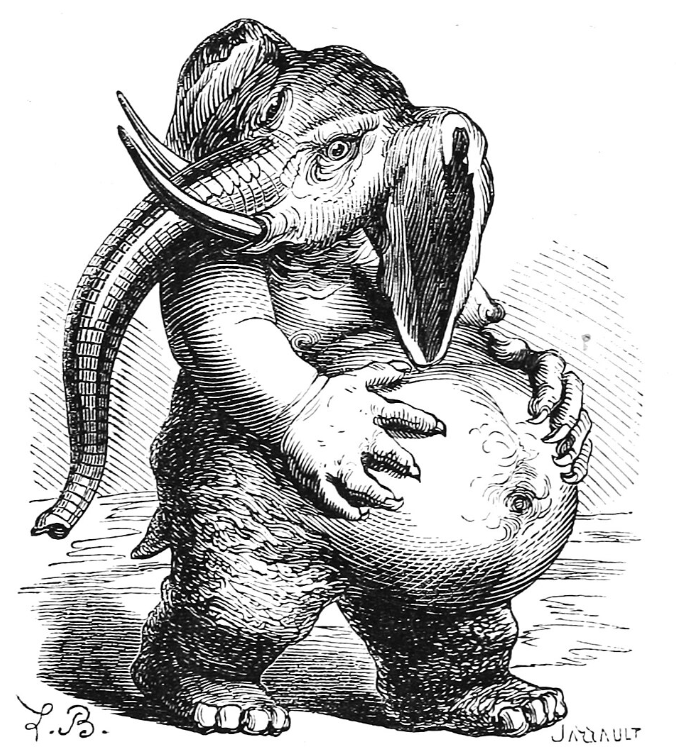
The ‘Freemason’s Quarterly Review’ (1934) interprets the “Serpentine Osiris” as an elephant, and seems to be connected to Samael-lilith. It describes the “Serpentine Osiris” as a composite solar-chthonic figure, Osiris in bovine form conjoined with the Serpent to symbolize the Sun’s descent into the underworld — an image later preserved in the constellation Capricornus and analogically expressed in the elephant, whose bull-like body and serpentine trunk were read as an Indianized form of this hybrid, a conception that closely parallels the Zoharic image of Samael (seen here as Set as Osiris’ shadow) as Samael “riding upon” the Serpent Lilith. In this interpretation, Samael corresponds to the planet Mars, Lilith to the planet Venus, and their joining forms Saturn, represented by the elephant in Persian manuscripts. These are the planets in the SPC, and the planet Mars in the SPC was seen as essentially “riding” Venus in conjunction, with Saturn overhead. In this interpretation, the planet Mars represents the trunk of the metaphorical elephant and the tusks are represented by the Venus and Saturnian crescent. The planet Saturn’s associated with both male and female deities (the ancient Indian mathematician Varāhamihira called Saturn a “hermaphrodite planet”), and could be made up of Samael and Lilith, the pair that form Behemoth and Leviathan. Samael and Saturn share some common assocations; both are represented by the Grim Reaper, and Lilith has the planetary symbol for Saturn on her sigil. The large stomach of Behemoth below could allude to a devouring aspect, as Saturn (Kronos) devours his children.
The idea that Baphomet could be related to Saturn (and also Osiris) has been explored by various occultists. In his 1944 book ‘Magic and Theory in Practice’, Crowley corresponds Baphomet to Capricornus, which is constellation ruled by Saturn. Meanwhile, Lévi included a description of Baphomet that included “Kronos” — the ruler of the Golden Age. The idea that Baphomet might be seen as Saturn, is hinted by the TV show Childhood’s End. Childhood’s End is an American-Australian TV show based on the 1953 novel of the same name, by Arthur Clarke. It follows the story of farmer Rikki Stormgren after a series of extraterrestrial sky-scraper sized spaceships arrive on Earth’s doorstep. Using advanced tech, the extraterrestrial race stuns the world by freezing commercial planes midair while communicating to Earth’s people through avatars in the form of their deceased loved ones. People react with fear and confusion to the extraterrestrial visitors, but rather than raining down laser-beam destruction on Earthlings, the aliens broadcast a message of peace. They say they’ve come to eliminate war and inequality and to usher in a “Golden Age” of peace and prosperity (the term “Golden Age” to describe the new world — under extraterrestrial rule — is said several times throughout the show). The extraterrestrials are dubbed the “Overlords” and in the days that follow they eliminate war and disease, setting the stage for the “Golden Age” of humanity. Mythologically, the Golden Age was associated with the reign of Saturn. As David Talbott says, in his book ‘The Saturn Myth’: “That Saturn had governed the “Golden Age” is a supreme tenet of ancient mysteries. With Osiris, the Egyptians constantly associated a vanished Golden Age”.
Even though the Overlords have good intentions, they impose their will in an authoritarian way — wielding immense technological power to mold the world into their Utopian vision. In many ways, the Overlords are like dictators and not everyone accepts them. The character Hugo Wainwrigh, who owns a media company, expresses his disdain for the Overlords’ governance over humanity and pitches gloom-ridden conspiracy theories about them, and a group is created called the Freedom League emboding humanity’s struggle for autonomy and self-determination. Despite commandeering control of Earth, we never get to see what the Overlords look like. From early on, we learn that the Overlords don’t want to reveal their true appearance, because they feel that humanity “isn’t ready”, and so Stormgren is chosen by the Overlords to act as their spokesperson — what one character calls “the sole spokesperson for an entire alien race”. The ambassador for the Overlords, Karellen, explains to Stormgren why they decided to invade, saying: “Humanity was on the verge of discovering interstellar travel, but the stars are not for man”. The Overlords believe humans are destroying themselves, and the Earth, and invaded because they deem humanity as too much of an immature species to continue on their evolutionary path alone. Eventually, the Earth’s people acclimate to the Overlords and Karellen decides to reveal himself. When he does people are shocked to see that he looks like our imagination of Satan.


The appearance of Karellen shares characteristics with Baphomet which was a horned-god that the Knights Templars worshipped. Aside from the obvious characteristics they share of being a winged, goat headed humanoid, as Karellen reveals himself, two children are on his either arm, which is the same as the statue of Baphomet in Salem. Baphomet’s sometimes said to be a non-human intelligence, variously described as a demon or god, or an esoteric representation of the harmony of opposites inspired by alchemical teachings. Lévi said that Baphomet represented the “equilibrium of opposites” which was essential to his magnetistic-magical notion of Astral Light and equated Baphomet with the “Goat of Mendes” which was believed to be “Banebdjedet” who was ostensibly the manifestation of Osiris. If we say that Karellen is a representation of Baphomet who’s possibly the manifestation of Osiris, this might explain why Karellen guided humanity into a “Golden Age”, because the Golden Age was originally tied to the reign of Osiris. In his 2021 book ‘Damn, You Just Got Bit!’, the American journalist Spiro Hamilton says: “Some Egyptians believed that Osiris would return at the end of time. His return would herald a Golden Age”.

Karellen in Childhood’s End is called a lion, and he’s red, making him a sort of red lion. Saturn, in the SPC, resembled a red lion, and this later became known as the “devouring red lion”. The element Sb acquired names like the “red lion” because of its behavior in fire: It aggressively consumes most “base” metals while leaving gold untouched, even cleaning it by removing impurities. This selective, destructive power led alchemists to associate Sb with Saturn (Kronos), the god who devoured his children. Since Saturn was traditionally linked to lead, Sb came to be called “sacred lead” or “philosophers’ lead”, understood as a higher — more spiritual refinement of that metal. Its dangerous and transformative nature also earned the titles: “Fiery dragon”, “red lion”, and “ultimate judge”, mirroing Saturn’s function as a cosmic sorter of souls. Regarding the origin of the lion being red in alchemical drawings, we have a connection made by Talbott in his book ‘The Saturn Myth’, whereby he hypothesizes an ancient celestial alignment that involved three planets: Mars, Venus, and Saturn (abbreviated here simply as the SPC). In the SPC, Mars appeared as a red mountain, World Tree, or Cosmic Mountain that connected to Saturn and Venus. This red mountain was later represented by a red lion. The symbolism of the red lion arose because the SPC (with the “red planet” Mars as the red body of the lion) appeared like the mane of a lion. The red lion in alchemy is a powerful symbol of the final stage of transformation, representing completion of the Great Work. It embodies the union of opposites — especially spirit and matter — when they’ve been purified through earlier stages, and is associated with the Philosopher’s Stone.

Lévi claimed that the god worshipped at the Egyptian place of Mendes was Baphomet, and according to Herodotus, this god was equated by the locals with Pan. A connection between Pan and Baphomet was thus established. In his 1898 book ‘Creation Records Discovered in Egypt’, the Scottish author George Clair explains: “Harpocrates [Horus] was worshipped at Mendes, with the holy ram or goat; an arrangement which seems to unite the two solstices”. François-René de Chateaubriand was a French writer and historian, considered one of the founders of Romanticism in French literature. He states quite simply: “Horus is the Pan of the Greeks” (see his 1870 book ‘Sur la Chute de l’Empre Romain’). Manly Palmer Hall explains, in his 1928 book ‘The Secret Teachings of All Ages’: “Pan was a composite creature, the upper part — with the exception of his horns — being human, and the lower part in the form of a goat. The pipes of Pan represent the natural harmony of the spheres, and the god himself is a symbol of Saturn, because this planet is enthroned in Capricorn, whose emblem is a goat”. The “Pan” Wikipedia page claims that the god could have roots in the Greek god Dionysus, who some scholars believe is the same god as Osiris. We have modern references to Pan like the 2006 movie Pan’s Labyrinth, where Pan’s shown with horns. In this movie Pan acts as a sort of tester, tempter, and gatekeeper. Labyrinths symbolized the entanglements and illusions in the lower world, through which the human soul wanders in search for truth. At the heart of the labyrinth usually dwells a bull-headed being, seeking to destroy the soul trapped within the maze of ignorance. Building on this idea, the RPG game Dungeons and Dragons includes a labyrinth at whose centre sits Baphomet.
David Talbott has suggested that the myth of the labyrinth derives from the SPC — a proposed celestial alignment that visually resembled the horns of a bull. This constellation of associations may help explain why myth places a bull at the centre of the labyrinth. Within the framework of the SPC, the bull’s “horns” were seen as the planet Saturn, and, as discussed above in this article, Baphomet can be interpreted as a symbolic representation of the SPC. Osiris was likewise at times represented in bovine form; the Greek philosopher Plutarch, in ‘Isis and Osiris’, records Osiris’ association with the bull. In a related vein, Egyptian sources referred to the planet Saturn as Ḥr kꜣ n pt (“Horus, Bull of Heaven”). Some believe that Horus is simply the resurrected form of the god Osiris. In his 1951 book ‘In the Beginning’, Immanuel Velikovsky argued that the Egyptians associated Osiris with Saturn (and recall above that Manly Palmer Hall connects Pan with Saturn), saying: “Osiris, the principal object of worship to the ancient Egyptians, is to be identified with the planet Saturn”. Both Osiris and Saturn were conceived as presiding over a primordial Golden Age. Finally — it has been suggested that the literary figure of Peter Pan (who Wikipedia curiously describes as representing a “golden-age”) drew inspiration from the god Pan. In some early interpretations of Barrie’s stories, Peter’s characterized in darker terms, with J. M. Barrie himself even referring to the character as a “demon-boy”.

In his 1856 book ‘Myths Traced to Their Primary Source Through Language’, philologist Morgan Kavanagh links Saturn to Satan. He explores the etymological and symbolic connections between Saturn and Satan, arguing that the two figures are the same. The author notes that, according to the Bible’s Revelation, the serpent is called Satan, and since Saturn and the serpent share characteristics, Saturn can also be equated with Satan. The Romans, Kavanagh claims, recognized this connection by linking Saturn with the underworld and lower regions. The key point is that Saturn and Satan are nearly identical in name. The letters “r” and “n” in Saturn are in apposition, meaning they can be dropped without changing the fundamental meaning, leaving “Satun”, which Kavanagh claims is essentially the same as Satan. The similarity in character between the two comes from the association of Saturn with lowness; an idea that also leads to Saturn’s connection with darkness and the underworld — similar to Satan. Kavanagh also delves deeper into the meaning of Saturn’s name, suggesting that the root “Sat” can be connected to words that imply hiding or concealment. To add, the name Saturn is connected to words that represent the Earth and hiding, including the Greek “lêthô” or “lathô”, which also means to hide. The root “sh” or “shad” in Saturn connects it to shades or shadows, further aligning Saturn with the god of the underworld. Therefore, Kavanagh links Saturn to the concepts of hiding, darkness, and the underworld, reinforcing the symbolic connection with Satan as a figure associated with lower, hidden realms. “Santa” is an anagram of Satan, and according to Manly Palmer Hall, in his book ‘The Secret Teachings of All Ages’, Santa’s another name for Saturn. Like Saturn, Santa also perennially metes out moral judgement, similar to Osiris and Mithra. The Finnish name for Santa Claus, Joulupukki — literally translates to “Christmas Goat”. Santa is an anagram of Satan — the goat.
The goat has always been recognized as one symbol for Satan. In the book ‘Trail of the Serpent’, by American writer Murl Vance, symbolic connections between Saturn and Satan are made. We read: “Higgins points out that Saturn, the lord of Hell and considered the most evil of the planets. Saturn in Hebrew-Chaldee is STVR, 666. Saturn was the mythological first king of Rome, and in Babylon bore the titles “God of Fire” and “Raging King”. Saturn is called “Star of the Sun”, “Lord of Hades”, “Son of the Sun”, etc. In Sanskrit, Saturn is connected with words meaning black, demon, serpent, goblin, peacock (worshiped in the East as a symbol of the Sun and of Satan), and “supervisor of magic”. There seems to be an actual etymological connection between the words “Saturn” and “Satan”, and it’s significant that Saturn was regularly represented as a goat and that the devils of the Greek-Roman world, the satyrs, derived their name from him and were likewise represented as goats”.

The letter “V” represents the Roman numeral 5, and the Hyades star cluster in the constellation Taurus forms a distinct V-shape composed of five primary stars. The name “Hyades” is both phonetically and orthographically similar to “Hades”, the Greek god of the underworld whose name also came to denote Hell. Aldebaran, the brightest star in Taurus, is referred to as the “red eye of the bull” because of its position marking the eye of the Taurus figure (♉︎). According to parallax measurements from the Hipparcos satellite, Aldebaran lies approximately 66.6 light-years from Earth. Some researchers have noted that the bull-god Taurus, when written in Hebrew-Chaldee as TVRS, contains the same letters as Sorath, with both names totaling 666 in Hebrew-Chaldee gematria (as discussed in ‘Trail of the Serpent’, by Murl Vance). Wayne Herschel, author of ‘The Hidden Records’, argues that the Phoenician letter ālep (𐤀) derives from the Taurus constellation, as the symbol closely resembles a sideways V or goat head. Herschel overlays the 𐤀 symbol onto a downward-pointing pentagram — the head of Baphomet — and observes a visual correspondence. When rotated 90 degrees, the symbol appears to align with Baphomet’s head. This comparison raises the possibility that the god associated with Taurus in ancient Egyptian and Greek traditions may also be symbolically linked to Baphomet.
In the 1934 ‘The Freemason’s Quarterly Review’, we read of an elephant-like “Serpentine Osiris”, with it potentially being linked to Baphomet: “The emblem of the solar luminary among the Egyptians was the bull’s head, or Osiris, which consists of the union of the solar circle, ⊙, with the lunar crescent, ☽, thus forming the common astronomical symbol, ♉︎, expressive of the constellation Taurus, and consisting of the union of the greater with the lesser light. The inferior Hemisphere of the globe being placed under the rule of the serpent, the Hieroglyphic invented to express the descent of the Sun into the regions of the serpent, or those of Hades, and Patala was the head of the bull, or Osiris, adjoined to the body of the serpent. This combination is recognized by mythologists as the serpentine Osiris, and is still retained, although obscured, in the form of the constellation Capricornus, which is compounded of a horned head, originally that of a bull, but at present converted into that of a goat, united to the body of a dragon, or fish. The serpentine Osiris, compounded of the bull and snake, is thus the prototype of the elephant, which consists of a bull’s, or Quadrupedal body — united to the snake, imagined to be discovered in the Proboscis of the animal. Hence the elephant is the Indian Serpentine Osiris, and is the emblem of the constellation Capricornus or inferior portal of the heavens”. In the Zohar, Samael’s described as “riding upon” and being joined to the Serpent. This is essentially the same as the “Serpentine Osiris”, as “Osiris adjoined to the Serpent”, as described in the 1934 book.

From the Templars’ alleged idol to Lévi’s magico-alchemical emblem, from Osiris, Horus, and Set to Saturn, Abraxas, and Adam Kadmon, Baphomet functions as a mirror of the divine fractured into opposites and striving toward reunion. Whether interpreted as the equilibrium of forces, the shadow of the celestial Trinity — or an esoteric map of human transformation — the figure consistently encodes the same perennial tension: Ascent and fall, light and darkness, spirit and matter.
 SATURN, CERN, AND THE CUBE OF ILLUSION
